Nine of Swords Meaning - Upright & Reversed Interpretation [Tarot Guide]
Nine of Swords
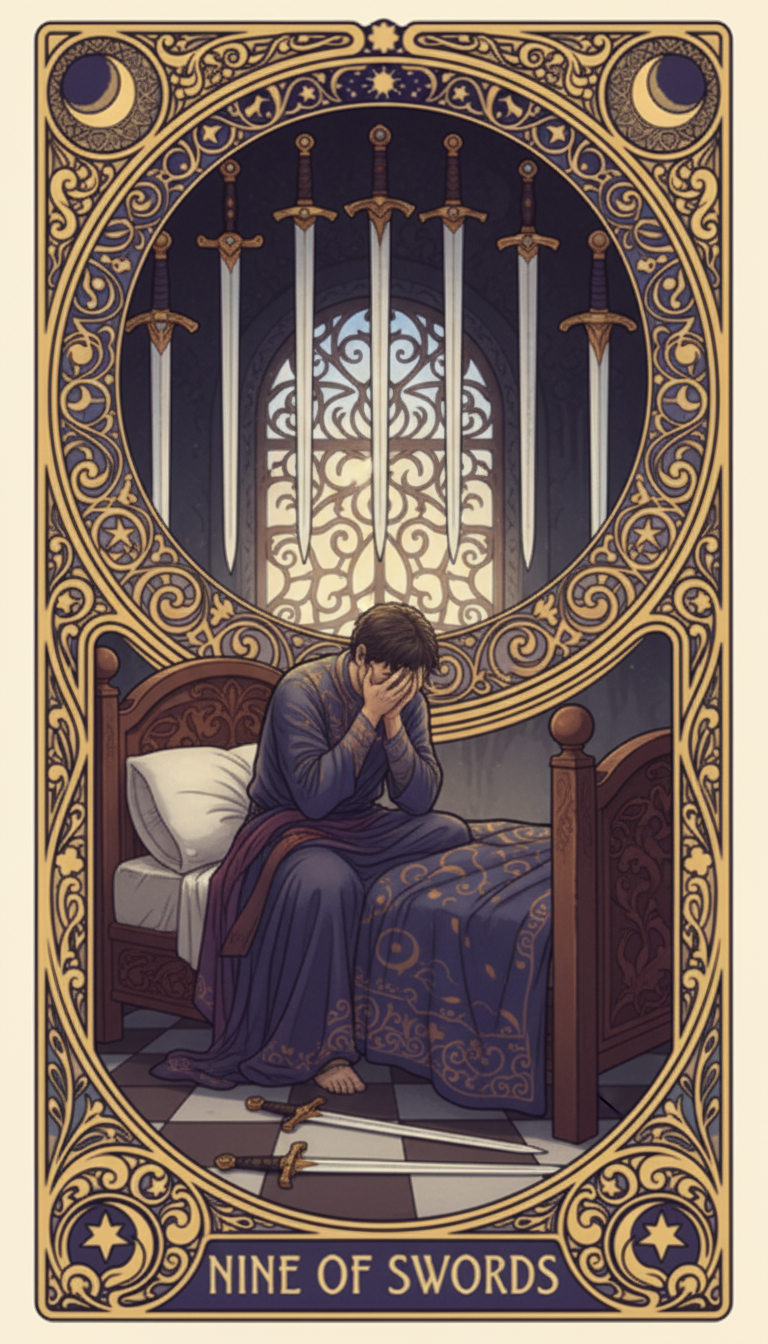
It is 3 AM and you are wide awake. The thing you are afraid of—the conversation, the diagnosis, the decision, the debt—has expanded in the dark until it feels like it will swallow everything. The Nine of Swords appears when anxiety has become your dominant experience, and the mind's ability to generate worst-case scenarios has far outpaced reality's ability to produce them. This card does not dismiss your fear. It tells you that the fear is real, but it is not the whole truth.
Card Overview
A figure sits bolt upright in bed, face buried in hands, consumed by anguish. Nine swords hang horizontally against a pitch-black wall behind them—not piercing the figure but hovering, suspended, oppressive. The blackness of the background is total: this is a card about what happens inside the mind when darkness removes every distraction and leaves you alone with your thoughts. The bed's carved panel depicts a scene of violence—one figure striking another—hinting that the source of this suffering is not present danger but remembered pain. The swords are the thoughts themselves: sharp, repetitive, and arranged in perfect rows like the systematic loops of an anxious mind.
Core Meanings
Upright
Anxiety, Fear, Nightmares, Mental anguish
The Nine of Swords upright is the tarot's most direct representation of psychological suffering. Anxiety that disrupts sleep. Guilt that replays the same scene endlessly. Fear that inflates a manageable problem into an existential catastrophe. The critical distinction this card draws: the suffering is absolutely real, but the catastrophe generating it is often not. Your mind has taken a genuine concern and amplified it beyond all proportion. The swords on the wall are not falling—they are hanging there, projections of a mind that cannot stop anticipating the worst.
Reversed
A glimmer of hope, Reaching out for help, Overcoming fear, First steps toward recovery
The Nine of Swords reversed marks the moment when the grip of anxiety begins to loosen. You told someone. You made the appointment. You looked at the bank statement you had been avoiding. The worst-case scenario you constructed in the dark did not survive contact with daylight. Recovery from this kind of suffering is not instantaneous—the reversed Nine does not promise that the anxiety disappears. It confirms that the trajectory has shifted from deepening crisis toward gradual relief.
URANIZE Editorial Insight: The Nine of Swords reversed is one of the most relieving cards our users encounter, because it validates what they suspected but were afraid to believe: that the worst is genuinely behind them. The pattern we see consistently is that this card appears not when the external problem is solved, but when the person finally takes the first concrete action to address it—making a phone call, opening an email, scheduling a conversation. The anxiety breaks not when the problem disappears, but when avoidance ends.
Love & Relationships
Upright
The Nine of Swords upright in love describes a relationship—or the absence of one—that has become a source of torment rather than comfort. Obsessive thoughts about a partner's fidelity. Catastrophic interpretations of every ambiguous text message. The inability to sleep because your mind replays every argument, every silence, every perceived rejection. Past romantic trauma is actively contaminating the present, making it impossible to experience current connection without filtering it through old pain.
Reversed
Reversed in love, the anxious spiral is slowing. You are beginning to separate past trauma from present reality—to recognize that your current partner is not the person who hurt you before, or that being single is not the permanent sentence your anxiety insisted it was. Talking about your fears with a trusted person, whether a friend, therapist, or the partner themselves, has reduced their power. Trust is returning in small, measurable increments.
Uranize Editorial Insight: The most common misinterpretation we see is treating tarot cards as fixed predictions rather than reflections of current energy patterns. The cards mirror your situation — they do not dictate it.
Career & Work
Upright
Professionally, the Nine of Swords describes work-related stress that has crossed from productive pressure into genuine psychological harm. Sunday-night dread that makes the weekend meaningless. The inability to disconnect because your mind rehearses Monday's problems all weekend. Imposter syndrome so intense that every email from a supervisor triggers a spike of panic. Performance anxiety that paradoxically degrades the performance it fears losing. Your mental health is not a secondary concern—it is the foundation on which every professional capability depends.
Reversed
Reversed at work, the crisis is beginning to resolve. You spoke to a manager about workload. You consulted a therapist about the anxiety. You discovered that the layoff rumor was unfounded, or that the mistake you obsessed over was noticed by no one. The professional fear that consumed your nights is diminishing as concrete information replaces imagined catastrophe. The lesson this reversal teaches: avoidance multiplies workplace anxiety; action reduces it.
Financial Outlook
Upright
Financially, the Nine of Swords represents money anxiety at its most paralyzing. Debt that generates shame. Bills that remain unopened because opening them makes the fear real. The 3 AM calculation of how long savings will last, performed with the pessimistic arithmetic that only insomnia can produce. The critical truth this card reveals: financial anxiety and financial reality are often dramatically different in scale. The fear is always worse than the spreadsheet.
Reversed
Reversed, financial anxiety is yielding to financial clarity. You opened the statements. You built a budget. You called the creditor. The number that terrorized you in the dark turned out to be manageable in daylight—or at least, it turned out to be a specific problem with specific solutions rather than an amorphous catastrophe. Financial recovery begins the moment you replace avoidance with information.
URANIZE Editorial Insight: The single most consistent pattern we observe with the Nine of Swords in financial readings: the anxiety is inversely proportional to the amount of concrete financial information the person has. Users who avoid looking at their accounts experience the most intense financial dread. Users who track their spending weekly—even when the numbers are bad—report dramatically lower anxiety. The card's practical prescription is simple: look at the number. The number is almost always less frightening than the void where the number should be.
Card Advice
The Nine of Swords acknowledges what you already know: this suffering is real, and it is exhausting. But the card also delivers one non-negotiable instruction—do not endure this alone in the dark. Anxiety thrives in isolation and silence. It shrinks when spoken aloud to another human being. The swords on the wall are not falling. The catastrophe in your mind has not happened. And the single most powerful thing you can do right now is tell someone what you are afraid of. Not to fix it. Just to say it out loud and discover that the words are survivable.
Uranize Editorial Insight: Experienced readers know that reversed cards are not inherently negative. They often represent internalized energy, delayed timing, or an invitation to look at the situation from an unconventional angle.
Related Cards
Reading this in May 2026: a fresh perspective
As of May 2026, the themes in this article take on slightly different weight depending on the reader's season of life. Try reading the techniques and frameworks below with your current situation in mind, especially around topics of 行動の加速.
Reading this in July 2026: a fresh perspective
As of July 2026, the themes in this article take on slightly different weight depending on the reader's season of life. Try reading the techniques and frameworks below with your current situation in mind, especially around topics of 対人関係の試練.
Reading this in September 2026: a fresh perspective
As of September 2026, the themes in this article take on slightly different weight depending on the reader's season of life. Try reading the techniques and frameworks below with your current situation in mind, especially around topics of 実りへの準備.
Frequently Asked Questions
What does the Nine of Swords mean in the upright position?
Acute psychological suffering—anxiety, insomnia, guilt, and fear that has expanded far beyond the actual scale of the problem generating it. This is the tarot's most direct depiction of a mind at war with itself. The card validates the pain while pointing out that the catastrophe being feared has not actually occurred and is likely far less severe than the mind's projection of it.
What does the Nine of Swords mean when reversed?
The beginning of relief. The reversed Nine appears when someone takes the first concrete step to address the anxiety—telling someone, seeking help, or simply looking at the problem they have been avoiding. The fear does not vanish instantly, but the direction shifts from escalation toward gradual recovery. The worst is behind you.
What does the Nine of Swords mean in a love reading?
Upright, it describes love that has become a source of torment—obsessive fear about a partner's feelings, past trauma contaminating present relationships, or the inability to sleep because romantic anxiety dominates your thoughts. Reversed, the anxious grip is loosening as you begin to separate old wounds from current reality and rebuild the capacity to trust.
Curious About This Card? Try a Reading on Uranize
The Nine of Swords acknowledges your suffering and asks you not to carry it alone. A tarot reading can help you separate real concerns from amplified fears — and find the first step toward relief.
Experience Your Personal Tarot Reading
Have a conversation with AI and receive a tarot reading tailored to your situation. Start for free right now.
Try Uranize NowNo login required to get started
Experience This Card's Meaning with AI Tarot
URANIZE's AI tarot interprets card meanings personalized to your situation. Dive deeper through unlimited chat conversations.
🃏Try AI Tarot Reading for FreeNo registration required — completely free
Related Articles
The Four Aces in Tarot: Seeds of New Beginnings in Every Suit [2026]
Explore the powerful meaning of all four tarot aces. Learn how Ace of Wands, Cups, Swords, and Pentacles signal new beginnings and pure potential in readings.
Five of Wands Meaning - Upright & Reversed Interpretation [Tarot Guide]
Discover the meaning of the Five of Wands tarot card. Detailed upright and reversed interpretations for love, career, and finances.
The High Priestess Tarot Card Meaning: Upright & Reversed Explained
Complete guide to The High Priestess tarot card meaning. Learn upright and reversed interpretations for love, career, finances, health, Yes/No readings, card co
Knight of Cups Meaning - Upright & Reversed Interpretation [Tarot Guide]
Discover the meaning of the Knight of Cups tarot card. Detailed upright and reversed interpretations for love, career, and finances.
Knight of Swords Meaning - Upright & Reversed Interpretation [Tarot Guide]
Discover the meaning of the Knight of Swords tarot card. Detailed upright and reversed interpretations for love, career, and finances.
The Hermit Tarot Card Meaning: Love, Wisdom & Yes or No
What does The Hermit tarot card really mean? Complete guide to upright & reversed meanings for love, career, finances, yes/no readings, and card combinations.